
I. Situation
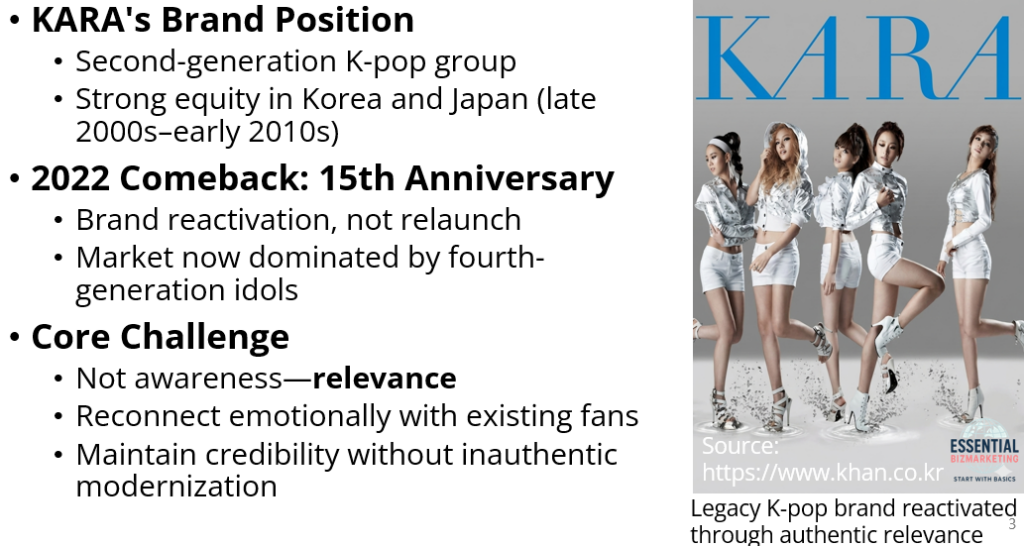
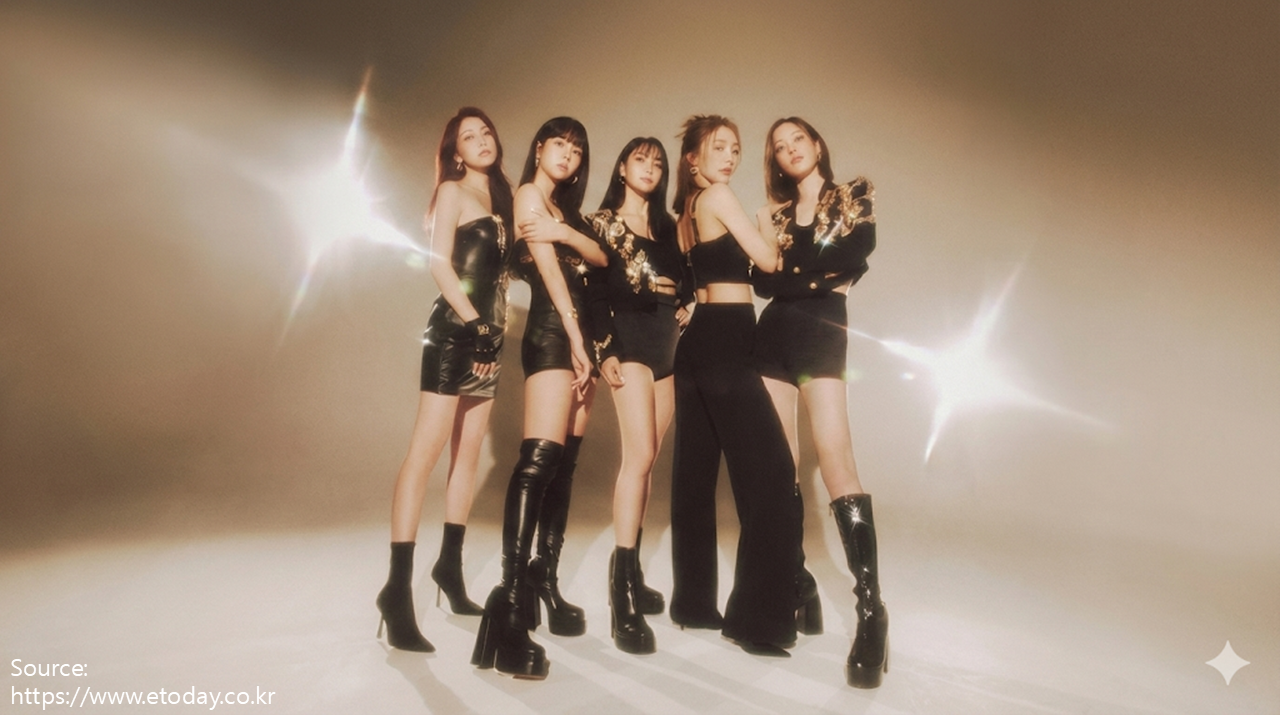
KARA is a second-generation K-pop group whose brand equity was built in the late 2000s and early 2010s, including strong recognition in both Korea and Japan. After years of limited group activity and major changes in the K-pop competitive landscape, the group returned in 2022 with a 15th-anniversary project, positioning the comeback as a brand reactivation rather than a conventional rookie-style relaunch. The core managerial challenge was not awareness—KARA already had name recognition—but relevance: could a legacy brand reconnect emotionally with existing fans while remaining credible in a market dominated by fourth-generation idols? This case examines how KARA’s comeback was structured to reactivate dormant brand equity without forcing the brand into an inauthentic modernization.
II. Reactivation vs. Repositioning
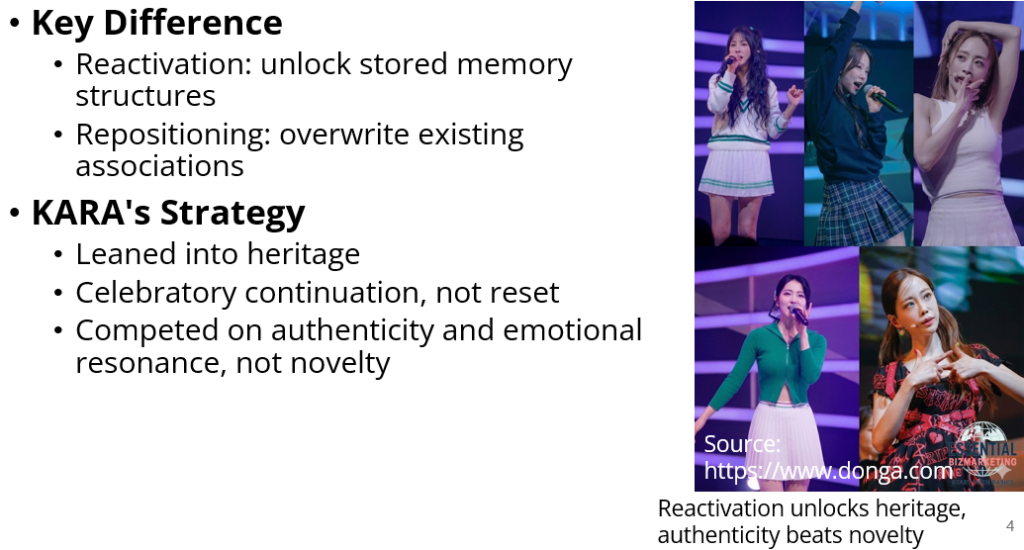
Brand reactivation differs from repositioning because the goal is to unlock stored memory structures rather than overwrite them. KARA’s strategy explicitly leaned into heritage, framing the return as a celebratory continuation of the group’s history rather than a reset. Media coverage emphasized the group’s longevity, shared past, and emotional significance to fans who had aged alongside the brand. This approach reduced risk: instead of competing head-to-head with current idols on novelty, KARA competed on authenticity and emotional resonance.
III. Tactical Design of the Comeback
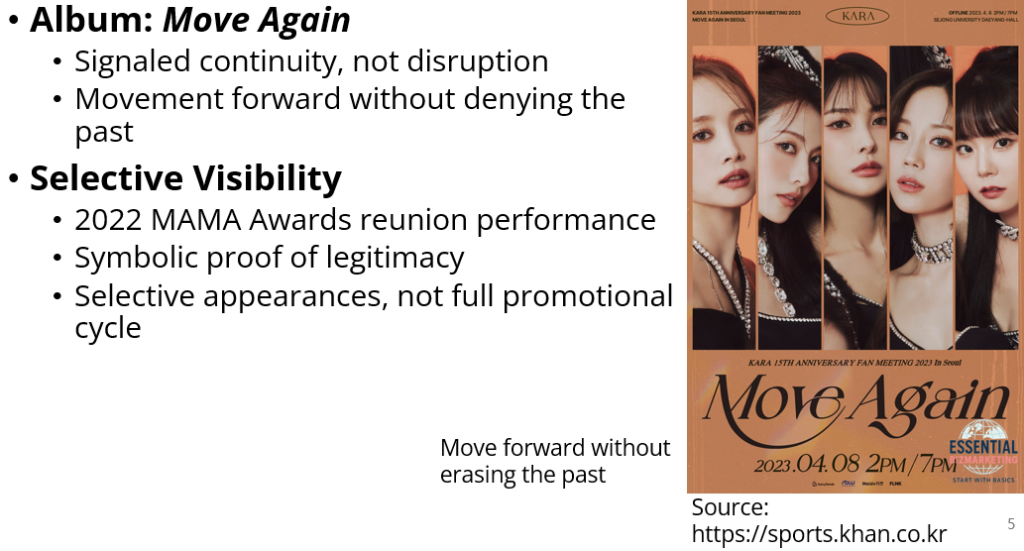
The 15th-anniversary album Move Again functioned as the central activation asset, signaling continuity rather than disruption. The title and messaging implied movement forward without denying the past, which is critical in legacy brand management. High-visibility stages, especially the group’s reunion performance at the 2022 MAMA Awards, acted as symbolic proof of return and legitimacy in the current K-pop ecosystem. Rather than oversaturating the market, appearances were selective, reinforcing the idea that this was a meaningful reactivation event, not a full-scale promotional cycle.
IV. Managing Member Composition and Brand Meaning
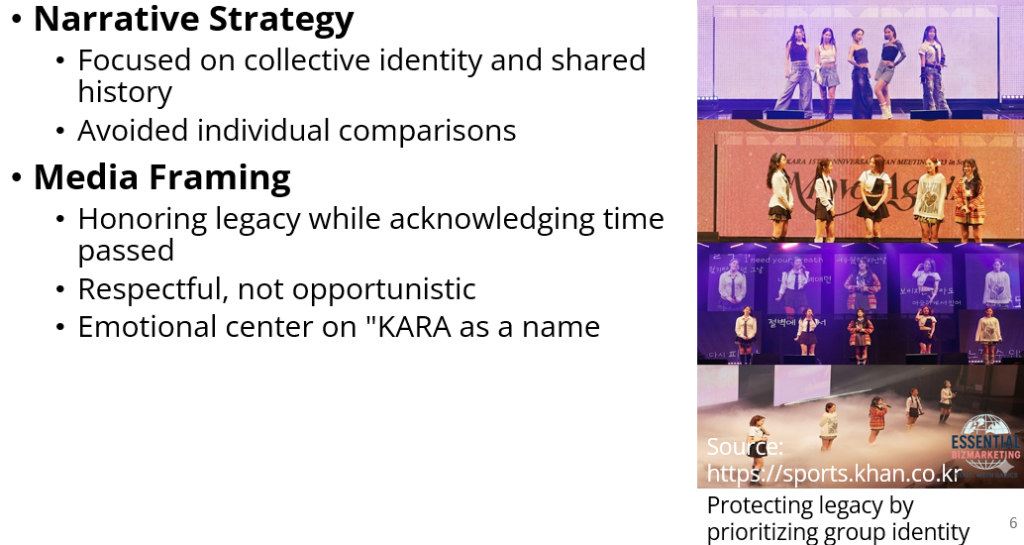
A key risk in KARA’s reactivation was member continuity, given the group’s long history and past disruptions. The comeback narrative carefully avoided internal detail and instead focused on collective identity and shared history, allowing audiences to process the brand at the group level rather than through individual comparisons. Billboard and other international outlets framed the return as honoring legacy while acknowledging time passed, which helped international audiences interpret the comeback as respectful rather than opportunistic. This framing protected brand meaning by keeping the emotional center on “KARA as a name,” not on lineup politics.
V. Market Response and Brand Effects
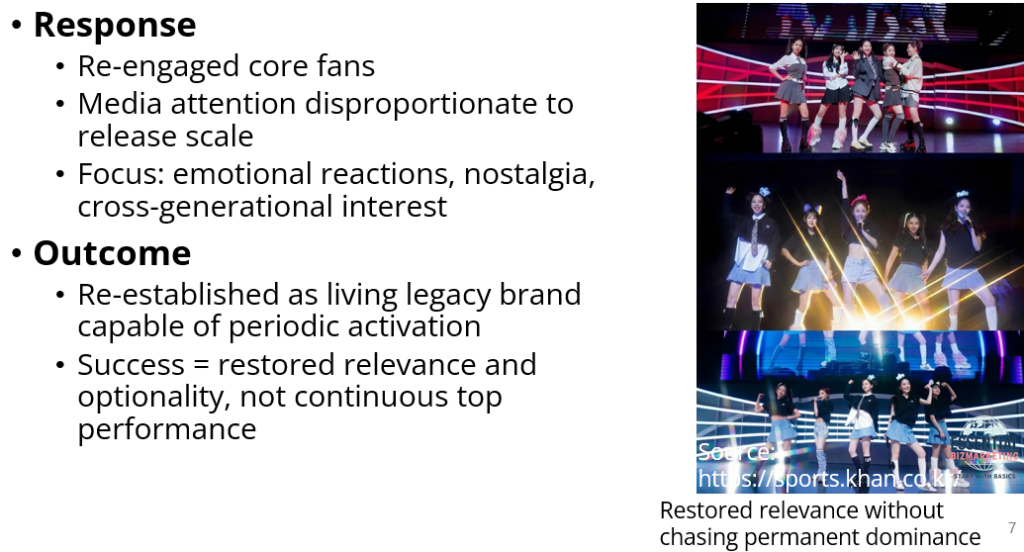
Initial responses showed that the reactivation succeeded in re-engaging core fans and generating media attention disproportionate to the scale of releases. Coverage highlighted emotional reactions, nostalgia, and cross-generational interest rather than chart competition alone. Importantly, the comeback did not attempt to claim permanent dominance in the current market; instead, it re-established KARA as a living legacy brand capable of periodic activation. This outcome aligns with reactivation theory, where success is measured by restored relevance and optionality, not continuous top-rank performance.
VI. Managerial Implications
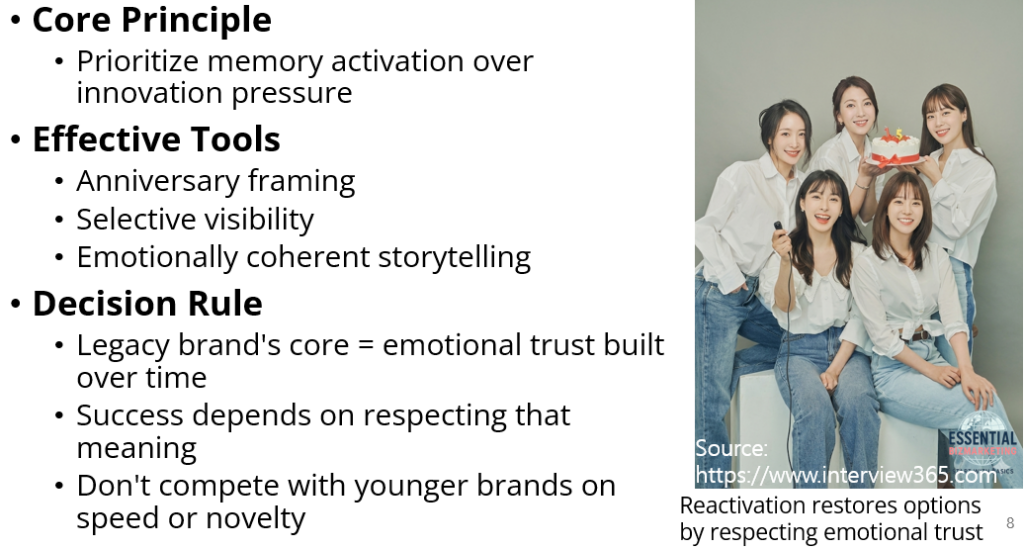
For managers handling legacy K-pop brands, KARA’s case illustrates that reactivation should prioritize memory activation over innovation pressure. Anniversary framing, selective visibility, and emotionally coherent storytelling can unlock dormant brand equity without forcing the brand into unnatural stylistic shifts. Reactivation should also be designed as an option-creating move: once relevance is restored, managers can decide whether to pursue further releases, tours, or symbolic appearances. The decision rule is clear—if a legacy brand’s core meaning is emotional trust built over time, successful reactivation depends on respect for that meaning, not on competing with younger brands on speed or novelty.
References
- Billboard. (2022). KARA’s ‘When I Move’ celebrates 15 years of the group’s legacy.
https://www.billboard.com/music/pop/kara-15th-anniversary-album-when-i-move-goo-hara-1235179724/ - The Korea Times. (2022). KARA writes new chapter with ‘Move Again’.
https://www.koreatimes.co.kr/entertainment/k-pop/20221205/kara-writes-new-chapter-with-move-again - The Korea Herald. (2022). KARA makes stunning full comeback at 2022 MAMA Awards.
https://www.koreaherald.com/article/3010926 - NME. (2022). KARA reunites on stage for first time in seven years at 2022 MAMA Awards.
https://www.nme.com/news/music/kara-on-stage-reunion-first-time-in-seven-years-2022-mama-awards-move-again-3346530 - KBS World. (2022). KARA to return with new album after seven years.
https://world.kbs.co.kr/service/contents_view.htm?board_seq=428768&id=&lang=e&menu_cate=enternews&page=177 - Wikipedia. (n.d.). Move Again (EP).
https://en.wikipedia.org/wiki/Move_Again
📁 Start exploring the Blog
🌐 Explore the Brand Management
📘 Or learn more About this site
🧵 Or follow along on X (Twitter)
📊 Want to dive into marketing strategy, branding, and digital tools? Start with our Marketing section
📺 Prefer video? Watch our lessons on YouTube
🔎 Looking for sharp perspectives on global trade and markets?
I recommend @GONOGO_Korea as a resource I trust and regularly learn from.